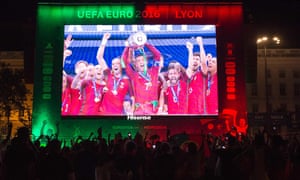
Portugal’s supporters celebrate after their – statistically underwhelming – Euro 2016 triumph. Photograph: Romain Lafabregue/AFP/Getty Images
“Given Portugal’s crowning as champions of Europe and becoming objectively the most annoying, mediocre team to have done so, what is the lowest points/points per game total that the winner of a major international tournament has achieved?” asks Ross. “That is, taking 90 mins as full-time so any extra-time/penalty wins are taken as draws.”
Nick Fredriksson (@NickTheStatsGuy) has gone to extraordinary lengths on this, so that we don’t have to. Nick looked into every World Cup, European Championship, Afcon, Copa América, Concacaf Gold Cup, Asian Cup and OFC Nations Cup – a total of 159 teams.
“I’ve done a load of research for this, time that possibly could have been better spent focusing on schoolwork, and the answer is … one point per game,” says Nick. “Czechoslovakia won the 1976 European Championships with all of their games going to extra-time or penalties. The problem is, there were only two games, meaning this is hardly a valid result.
“With a minimum of five matches, the lowest points-per-game average is 1.29, by … Portugal at Euro 2016! Yep, statistically speaking, the Portuguese are the least impressive winners of a major international tournament. In case you’re wondering, the lowest at a Copa América is 1.67, by Argentina in 1993, and the lowest at a World Cup is Argentina’s 2.00 in 1978.”
Nick has also provided a link to the full table, which proves emphatically that Canada’s Concacaf Gold Cup winners of 2000 weren’t all that.
“I’ve done a load of research for this, time that possibly could have been better spent focusing on schoolwork, and the answer is … one point per game,” says Nick. “Czechoslovakia won the 1976 European Championships with all of their games going to extra-time or penalties. The problem is, there were only two games, meaning this is hardly a valid result.
“With a minimum of five matches, the lowest points-per-game average is 1.29, by … Portugal at Euro 2016! Yep, statistically speaking, the Portuguese are the least impressive winners of a major international tournament. In case you’re wondering, the lowest at a Copa América is 1.67, by Argentina in 1993, and the lowest at a World Cup is Argentina’s 2.00 in 1978.”
Nick has also provided a link to the full table, which proves emphatically that Canada’s Concacaf Gold Cup winners of 2000 weren’t all that.
“England’s team for their opening game of Euro 2016 against Russia contained no Leicester players,” notes Adam Glass. “Is this the first time England have not included a single player from the league champions in their opening game of a major tournament?”
The answer, Adam, is no. It has happened four times in the past, most recently in 1992. England’s squad for Euro 92 included two players from the champions Leeds, Tony Dorigo and David Batty, but neither started the opening match, a 0-0 draw against Denmark. This was the team selected by Graham Taylor: Woods; Curle, Keown, Walker, Pearce; Steven, Platt, Palmer, Merson; Lineker, Smith. David Batty did start the other group games, playing in midfield in the 0-0 draw against France, as well as – and you’ll like this – at right-back in the infamous 2-1 defeat by Sweden.
It also happened at the 1986 World Cup in Mexico. The champions Liverpool werelargely made up of Scottish, Welsh and Irish stars, and did not have a single player in the England squad, never mind the team. Paul Walsh and Sammy Lee both won their final caps in 1984 and Steve McMahon did not make his debut until 1988. Two other players in the Double-winning squad eligible for England – Gary Ablett and Craig Johnston – were never capped.
Joe Mercer’s Manchester City had no players in the team that started Euro ‘68 against Yugoslavia, although Mike Summerbee and Colin Bell were in the squad. And Ipswich’s surprise champions of 1961-62 were not represented in England’s World Cup squad, even though Ray Crawford and Ted Phillips scored 73 goals between them that season.
Last week, we looked at British pundits who were used in other countries during Euro 2016. A few of you suggested Michael Robinson, who missed out on a technicality but is worth a mention anyway. “Just a quick mention for Michael Robinson, who is a big star in Spain,” says Ken Pummell. “Unfortunately he did no punditry for this year’s Euros because Movistar, who he works for, would not stump up the cash to show the games. Indeed half the games were not shown in Spain at all.”
Akshay Kulkarni has another name to add to the list. “My country (India) had Robbie Fowler on for the majority of the group stages during its coverage. There was not even a hint of him attempting the local language (Hindi) and his disdain for the dodgy refereeing, and his appreciation of Liverpool players, was totally in English.
“There were a set of Hindi commentators (rather comically attempting foreign intonations) for all the matches, but post and pre-match analysis defaulted to English. This also meant that one of the pundits, India’s football captain Sunil Chhetri, had to make do with his staccato English, which meant all analyses were a game of ‘Which pronunciation would be mangled next?’, won each day by either Fowler or Chhetri.
“I think the ungodly timing of the matches (late games would end at 2.30am each day) got to Fowler, however, because he disappeared midway through the tournament. Would you believe it, David James showed up in his stead. What with him scuttling around Norway and India, I really think the poor sap wants his opinions plastered everywhere. At least his disdain for the goalkeeping techniques were more objective than Fowler’s penalty shouts.”
“Why did Manchester United play their ‘home leg’ of the 1977-78 Cup Winners’ Cup clash with Saint Etienne in Plymouth, of all places?” asked Chris Priest in 2005. “And have there been other baffling venues for similarly important games?”
The why part of Chris’s question was easy to answer: United’s hooligans went on the rampage in the first leg in France and the club were chucked out of the competition – only to be reinstated on appeal on condition that they played their “home” leg at least 200km from Old Trafford.
United chose Plymouth, bizarrely, and won the second leg 2-0 to progress 3-1 on aggregate. The club’s European sojourn didn’t last long, however: they lost 6-5 on aggregate to Porto in the next round.
As for other baffling venues for important matches, surely the strangest was the Nou Camp for Leeds’ replayed European Cup tie with Stuttgart in 1992-93. Leeds went out of the competition on away goals, but were given a reprieve when it was discovered that Stuttgart fielded four foreign players (the rule was three at the time). Uefa decided on a one-off match on a Friday night, and Leeds sneaked through 2-1 in an eerily deserted stadium thanks to substitute Carl Shutt’s winner.
“When Edinburgh City hosted Livingston last week, Livingston, formerly Meadowbank Thistle, headed back for a competitive game at their former home ground, now Edinburgh City’s home stadium. Is this a unique circumstance?” asks Ian Smith.
“During some betting research on the Swedish League, I noticed that IFK Norrköping have retired the No18 shirt in honour of Icelandic forward Stefan Thordason,” writes Colm Noone. “During two spells at the club (2005–2007, 2009) his league record is a mere 25 goals in 87 appearances. This goalscoring ratio hardly seems to merit the retirement of a striker’s shirt number. Why was his shirt number retired and has anyone done so little to merit such an accolade or being awarded an even greater honour by a club (excluding posthumous as a mark of respect, obviously)?”
“Goalkeeper Adam Bogdan recently moved on loan to Wigan Athletic, joining his former Bolton Wanderers team-mate and fellow goalkeeper Jussi Jaaskelainen at the DW Stadium,” notes Ben Polak. “This made me think, are they the first goalkeepers to be first and second choice goalkeepers for two different teams?”
“Which international manager was oldest at the time of his appointment?” tweets Jim McGrath.
“Given Portugal’s crowning as champions of Europe and becoming objectively the most annoying, mediocre team to have done so, what is the lowest points/points per game total that the winner of a major international tournament has achieved?” asks Ross. “That is, taking 90 mins as full-time so any extra-time/penalty wins are taken as draws.”
Nick Fredriksson (@NickTheStatsGuy) has gone to extraordinary lengths on this, so that we don’t have to. Nick looked into every World Cup, European Championship, Afcon, Copa América, Concacaf Gold Cup, Asian Cup and OFC Nations Cup – a total of 159 teams.
“I’ve done a load of research for this, time that possibly could have been better spent focusing on schoolwork, and the answer is … one point per game,” says Nick. “Czechoslovakia won the 1976 European Championships with all of their games going to extra-time or penalties. The problem is, there were only two games, meaning this is hardly a valid result.
“With a minimum of five matches, the lowest points-per-game average is 1.29, by … Portugal at Euro 2016! Yep, statistically speaking, the Portuguese are the least impressive winners of a major international tournament. In case you’re wondering, the lowest at a Copa América is 1.67, by Argentina in 1993, and the lowest at a World Cup is Argentina’s 2.00 in 1978.”
Nick has also provided a link to the full table, which proves emphatically that Canada’s Concacaf Gold Cup winners of 2000 weren’t all that.
“I’ve done a load of research for this, time that possibly could have been better spent focusing on schoolwork, and the answer is … one point per game,” says Nick. “Czechoslovakia won the 1976 European Championships with all of their games going to extra-time or penalties. The problem is, there were only two games, meaning this is hardly a valid result.
“With a minimum of five matches, the lowest points-per-game average is 1.29, by … Portugal at Euro 2016! Yep, statistically speaking, the Portuguese are the least impressive winners of a major international tournament. In case you’re wondering, the lowest at a Copa América is 1.67, by Argentina in 1993, and the lowest at a World Cup is Argentina’s 2.00 in 1978.”
Nick has also provided a link to the full table, which proves emphatically that Canada’s Concacaf Gold Cup winners of 2000 weren’t all that.
“England’s team for their opening game of Euro 2016 against Russia contained no Leicester players,” notes Adam Glass. “Is this the first time England have not included a single player from the league champions in their opening game of a major tournament?”
The answer, Adam, is no. It has happened four times in the past, most recently in 1992. England’s squad for Euro 92 included two players from the champions Leeds, Tony Dorigo and David Batty, but neither started the opening match, a 0-0 draw against Denmark. This was the team selected by Graham Taylor: Woods; Curle, Keown, Walker, Pearce; Steven, Platt, Palmer, Merson; Lineker, Smith. David Batty did start the other group games, playing in midfield in the 0-0 draw against France, as well as – and you’ll like this – at right-back in the infamous 2-1 defeat by Sweden.
It also happened at the 1986 World Cup in Mexico. The champions Liverpool werelargely made up of Scottish, Welsh and Irish stars, and did not have a single player in the England squad, never mind the team. Paul Walsh and Sammy Lee both won their final caps in 1984 and Steve McMahon did not make his debut until 1988. Two other players in the Double-winning squad eligible for England – Gary Ablett and Craig Johnston – were never capped.
Joe Mercer’s Manchester City had no players in the team that started Euro ‘68 against Yugoslavia, although Mike Summerbee and Colin Bell were in the squad. And Ipswich’s surprise champions of 1961-62 were not represented in England’s World Cup squad, even though Ray Crawford and Ted Phillips scored 73 goals between them that season.
Last week, we looked at British pundits who were used in other countries during Euro 2016. A few of you suggested Michael Robinson, who missed out on a technicality but is worth a mention anyway. “Just a quick mention for Michael Robinson, who is a big star in Spain,” says Ken Pummell. “Unfortunately he did no punditry for this year’s Euros because Movistar, who he works for, would not stump up the cash to show the games. Indeed half the games were not shown in Spain at all.”
Akshay Kulkarni has another name to add to the list. “My country (India) had Robbie Fowler on for the majority of the group stages during its coverage. There was not even a hint of him attempting the local language (Hindi) and his disdain for the dodgy refereeing, and his appreciation of Liverpool players, was totally in English.
“There were a set of Hindi commentators (rather comically attempting foreign intonations) for all the matches, but post and pre-match analysis defaulted to English. This also meant that one of the pundits, India’s football captain Sunil Chhetri, had to make do with his staccato English, which meant all analyses were a game of ‘Which pronunciation would be mangled next?’, won each day by either Fowler or Chhetri.
“I think the ungodly timing of the matches (late games would end at 2.30am each day) got to Fowler, however, because he disappeared midway through the tournament. Would you believe it, David James showed up in his stead. What with him scuttling around Norway and India, I really think the poor sap wants his opinions plastered everywhere. At least his disdain for the goalkeeping techniques were more objective than Fowler’s penalty shouts.”
“Why did Manchester United play their ‘home leg’ of the 1977-78 Cup Winners’ Cup clash with Saint Etienne in Plymouth, of all places?” asked Chris Priest in 2005. “And have there been other baffling venues for similarly important games?”
The why part of Chris’s question was easy to answer: United’s hooligans went on the rampage in the first leg in France and the club were chucked out of the competition – only to be reinstated on appeal on condition that they played their “home” leg at least 200km from Old Trafford.
United chose Plymouth, bizarrely, and won the second leg 2-0 to progress 3-1 on aggregate. The club’s European sojourn didn’t last long, however: they lost 6-5 on aggregate to Porto in the next round.
As for other baffling venues for important matches, surely the strangest was the Nou Camp for Leeds’ replayed European Cup tie with Stuttgart in 1992-93. Leeds went out of the competition on away goals, but were given a reprieve when it was discovered that Stuttgart fielded four foreign players (the rule was three at the time). Uefa decided on a one-off match on a Friday night, and Leeds sneaked through 2-1 in an eerily deserted stadium thanks to substitute Carl Shutt’s winner.
“When Edinburgh City hosted Livingston last week, Livingston, formerly Meadowbank Thistle, headed back for a competitive game at their former home ground, now Edinburgh City’s home stadium. Is this a unique circumstance?” asks Ian Smith.
“During some betting research on the Swedish League, I noticed that IFK Norrköping have retired the No18 shirt in honour of Icelandic forward Stefan Thordason,” writes Colm Noone. “During two spells at the club (2005–2007, 2009) his league record is a mere 25 goals in 87 appearances. This goalscoring ratio hardly seems to merit the retirement of a striker’s shirt number. Why was his shirt number retired and has anyone done so little to merit such an accolade or being awarded an even greater honour by a club (excluding posthumous as a mark of respect, obviously)?”
“Goalkeeper Adam Bogdan recently moved on loan to Wigan Athletic, joining his former Bolton Wanderers team-mate and fellow goalkeeper Jussi Jaaskelainen at the DW Stadium,” notes Ben Polak. “This made me think, are they the first goalkeepers to be first and second choice goalkeepers for two different teams?”
“Which international manager was oldest at the time of his appointment?” tweets Jim McGrath.

Không có nhận xét nào:
Đăng nhận xét